If your cat wakes you at 5 a.m. for breakfast – or you've ever rushed home from work because the food bowl sat empty since morning – an automatic cat feeder solves a very real problem. It dispenses a measured portion of dry food at set times, so your cat gets consistent meals whether you're in the next room or 500 miles away.
But automatic feeders aren't all equal. Some jam with oddly shaped kibble, some fail when the power blinks, and some are so loud they scare the cat they're supposed to feed. We analyzed the most popular automatic cat feeders of 2026: comparing capacity, portion control, anti-jam design, power options, app features, and owner satisfaction across tens of thousands of verified Amazon reviews. These are the feeders that consistently do their one job – feed the cat, on time, every time.
| Product | Key Benefit | Price Range | Link |
|---|---|---|---|
| Automatic Cat Feeder 4L with Anti-Jam Design | Best Overall | $40–60 | Check Price |
| PETLIBRO WiFi Automatic Cat Feeder for 2 Cats | Best Smart/WiFi | $80–100 | Check Price |
| VOLUAS Automatic Cat Feeder 4L with Voice Recorder | Best Value | $45–65 | Check Price |
| Automatic Cat Feeder 2L – Budget Timed Feeder | Best Budget | $35–50 | Check Price |
| Automatic Cat Feeder 4L Timed – Multi-Cat Capacity | Best for Multiple Cats | $40–60 | Check Price |
| Automatic Cat Feeder 4L Timed – Portion Control Specialist | Best Portion Control | $40–60 | Check Price |
Why Use an Automatic Cat Feeder
The case for an automatic feeder is mostly about consistency – and portion control. Veterinary estimates suggest a large share of pet cats are overweight, and free-feeding (leaving a full bowl out all day) is one of the main contributors. Cats that eat on demand tend to graze, and grazing cats tend to gain weight.
An automatic feeder replaces the "bottomless bowl" with fixed portions at fixed times. That brings several practical wins:
- Portion control: set a portion size (e.g. 1–16 portions per meal) and stick to it – no more eyeballing the scoop
- Consistent schedule: cats thrive on routine; a feeder delivers breakfast at 7:00 even on weekends
- Busy owners: no more rushing home at lunchtime for a hungry cat
- Vacations & weekends away: a 4L feeder can cover several days of meals on its own
- Kittens and seniors: many models support 1–6 small meals per day, which suits cats that need frequent small portions
Two honest caveats: automatic feeders are designed for dry food only – wet food can spoil inside the hopper – and they're a feeding aid, not a replacement for your attention. Your cat still needs you for play, grooming, and check-ins. But for the daily mechanics of feeding, a good feeder is genuinely liberating.
How We Selected & Compared
- Data: technical specs from manufacturers (capacity, portion range, power source, anti-jam design, app support)
- Owner satisfaction: aggregated ratings from 40,000+ verified Amazon reviews
- Long-term reports: recurring complaints about jamming, battery life, cleaning difficulty, and dispenser accuracy
- Value: price vs. what you actually get – no overpriced gimmicks, no missing essentials
The 6 Best Automatic Cat Feeders
Automatic Cat Feeder 4L with Anti-Jam Design
Best Overall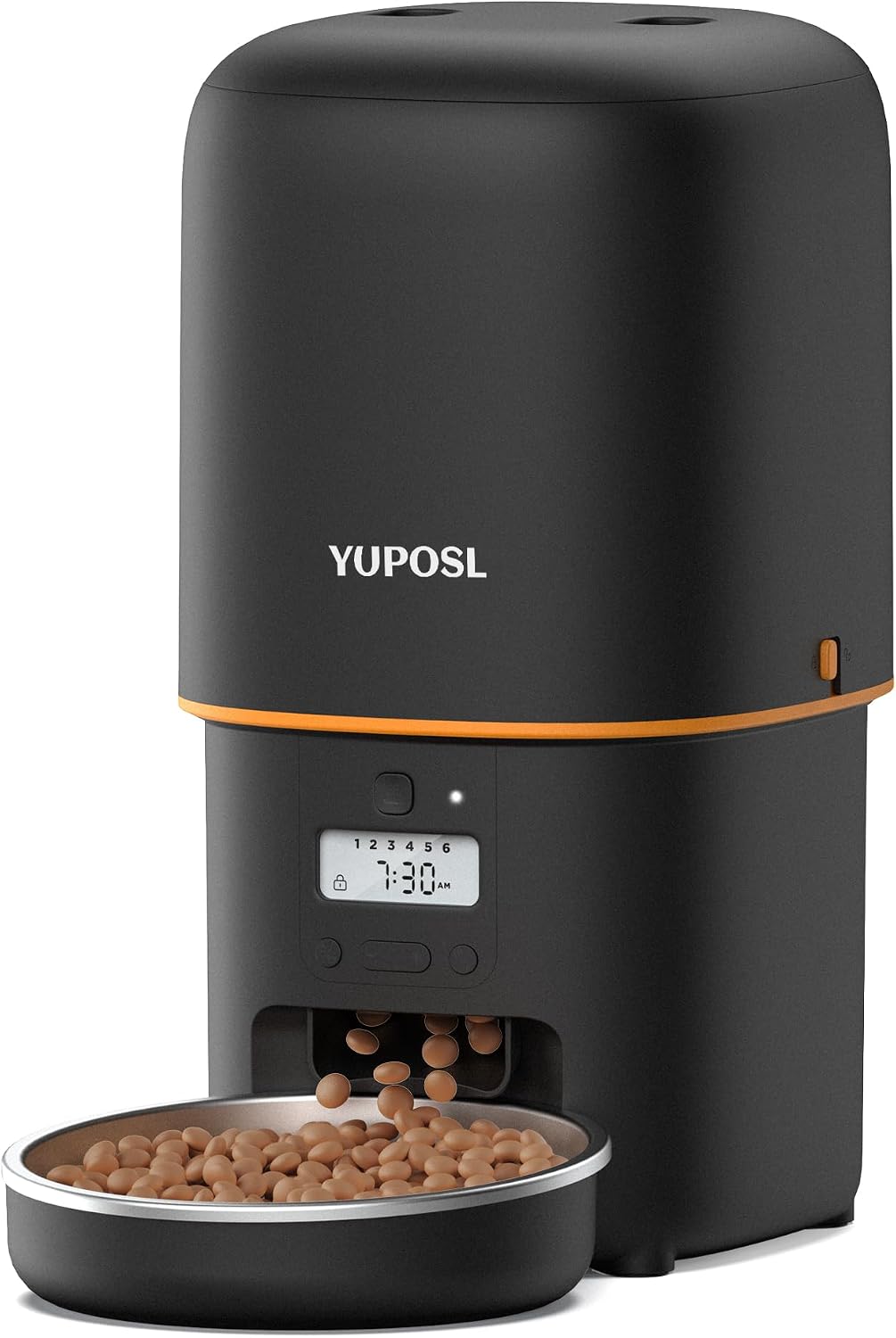
- Capacity
- 4 L
- Features
- Anti-jam
- Price range
- $40–60
★ 4.4/5 from 12,373 verified Amazon reviews. The strongest all-rounder in our analysis and our pick for most households. A 4L hopper covers weeks of meals, the anti-jam design tackles the single most common feeder complaint (stuck kibble), and the claimed battery life of over 180 days means you're not constantly changing batteries. The stainless steel bowl is a nice hygiene upgrade over plastic – easier to clean and less prone to scratches where bacteria can hide. Owners across thousands of reviews consistently report reliable dispensing and easy setup.
- Pros
- Large 4L capacity – weeks of meals for one cat
- Anti-jam design reduces stuck-kibble failures
- 180+ day battery life, low maintenance
- Stainless steel bowl, easy to clean
- Cons
- No WiFi/app control – timed only
- Dry food only
PETLIBRO WiFi Automatic Cat Feeder for 2 Cats
Best Smart/WiFi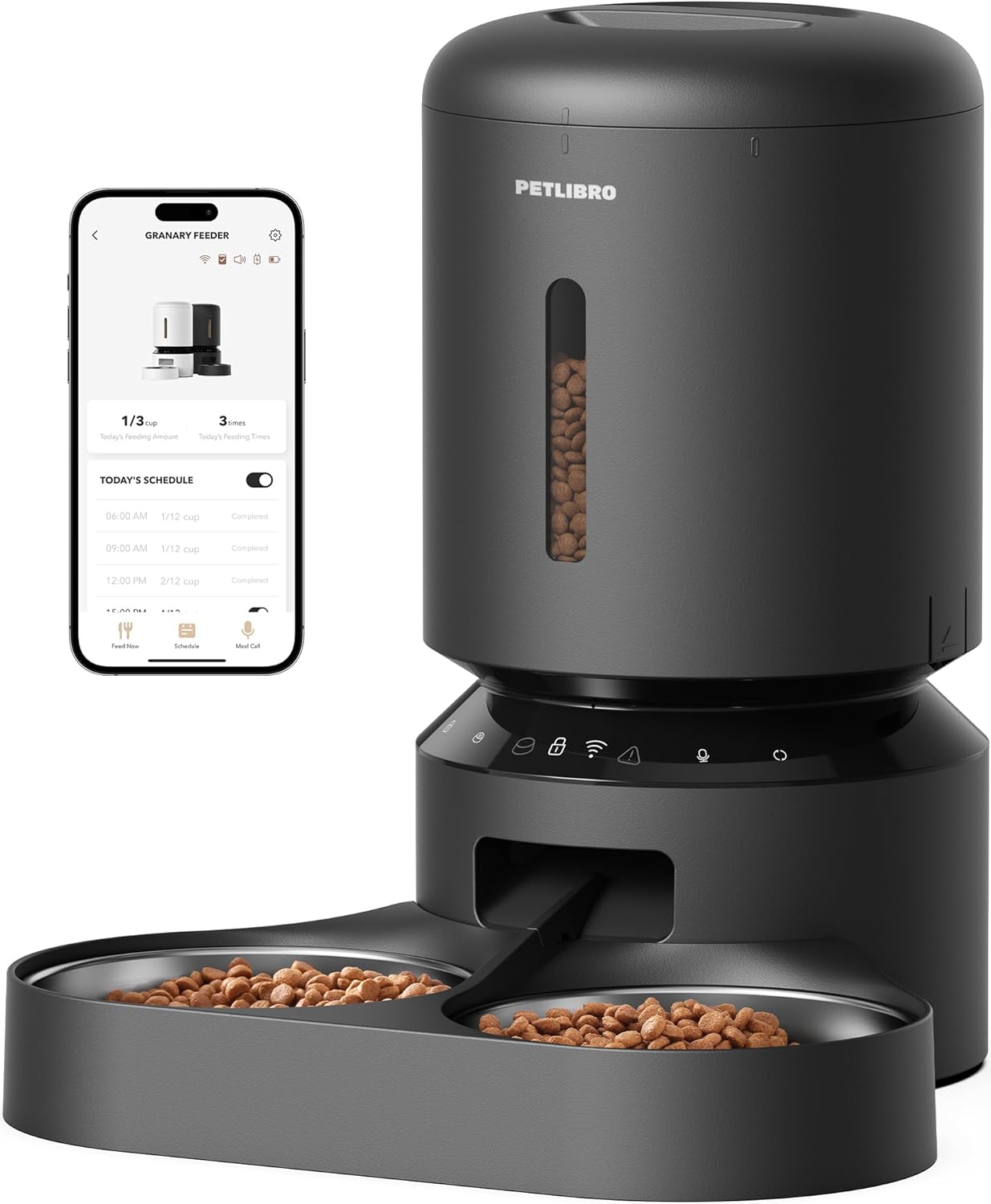
- Features
- WiFi
- Price range
- $80–100
★ 4.0/5 from 10,402 verified Amazon reviews. The smartest feeder in our list, and the only one with app control. Built for multi-cat homes: a 5L hopper is the largest capacity here, and the dual stainless steel bowls let two cats eat side by side without fighting over a single dish. PETLIBRO's airtight Lock-Fresh technology seals the hopper to keep dry food crisp, and the low-food sensor warns you before the hopper runs dry. App scheduling works over both 5G and 2.4G WiFi, which matters because many smart feeders only support 2.4G networks. The one trade-off: the largest price tag in this lineup.
- Pros
- Full WiFi/app scheduling and remote feeding
- Biggest capacity here – 5L
- Dual stainless steel bowls for two cats
- Airtight hopper keeps kibble fresh; low-food alerts
- Cons
- Most expensive option
- Rating slightly lower (4.0) than top pick
- Depends on WiFi and app for full features
VOLUAS Automatic Cat Feeder 4L with Voice Recorder
Best Value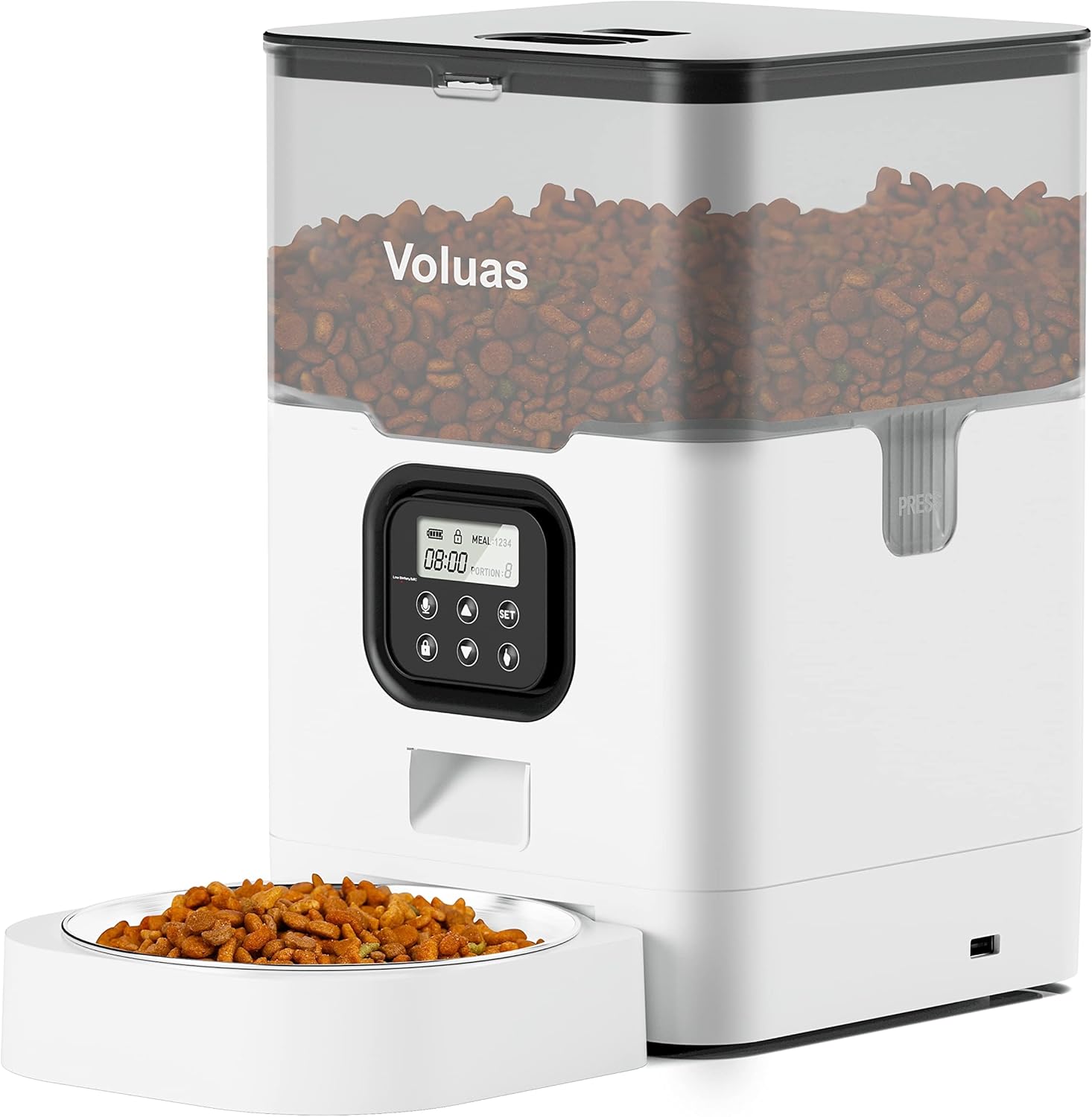
- Capacity
- 4 L
- Price range
- $45–65
★ 4.4/5 from 2,962 verified Amazon reviews. The value pick: a 4L timed feeder with programmable portion control at a mid-range price, backed by one of the strongest rating-to-price ratios in our analysis. It supports up to 4 meals daily, runs on dual power supply (plug-in with battery backup), and keeps its schedule through power outages thanks to power-off memory. The standout feature for the price is the 10-second voice recorder – you can record yourself calling the cat to dinner, which many owners say their cats respond to. A smart choice if you want the essentials done well without paying for WiFi.
- Pros
- Great price for a 4L timed feeder
- Dual power supply + power-off memory
- 10-second voice recorder – call your cat to meals
- Programmable portion control
- Cons
- No WiFi or app control
- Only 4 meals/day max (others do 6)
- Fewer reviews than the top picks
Automatic Cat Feeder 2L – Budget Timed Feeder
Best Budget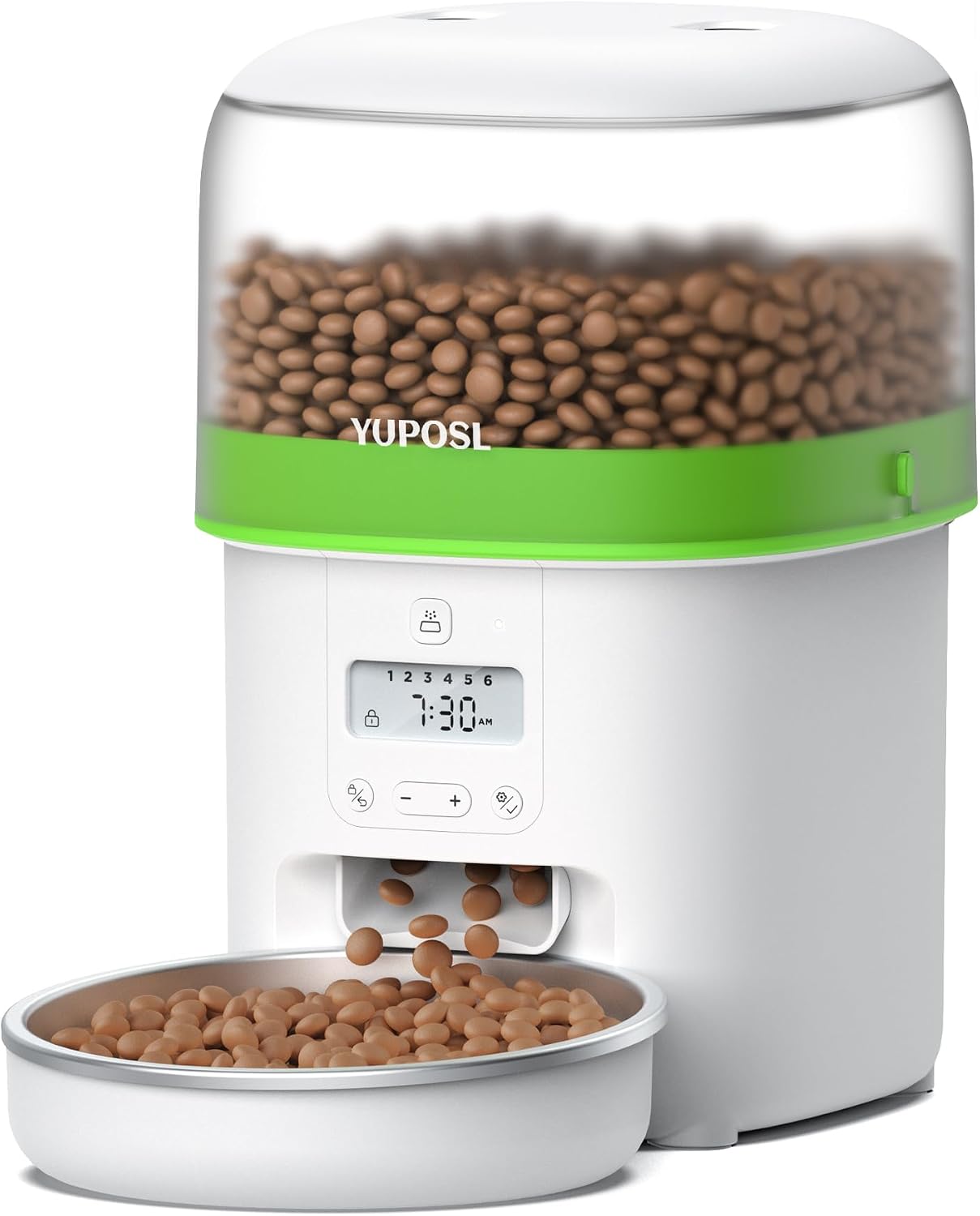
- Capacity
- 2 L
- Features
- Timed
- Price range
- $35–50
★ 4.4/5 from 5,156 verified Amazon reviews. The budget pick that still gets the fundamentals right. A 2L hopper is smaller than the 4L models – typically one to two weeks of meals for a single cat – but the flexible programming (1–6 meals per day, 1–16 portions per meal) matches the pricier feeders, and the claimed 180-day battery life is excellent at this price. The included desiccant bag helps keep dry food fresh inside the hopper. Also suitable for small dogs, per the manufacturer. If you just need a reliable, no-frills feeder for one cat, this is the sweet spot.
- Pros
- Lowest price in our lineup
- 180-day battery life
- Flexible 1–6 meals, 1–16 portions
- Desiccant bag keeps kibble fresh
- Cons
- 2L capacity needs more frequent refills
- No WiFi/app control
- Not ideal for multi-cat homes
Automatic Cat Feeder 4L Timed – Multi-Cat Capacity
Best for Multiple Cats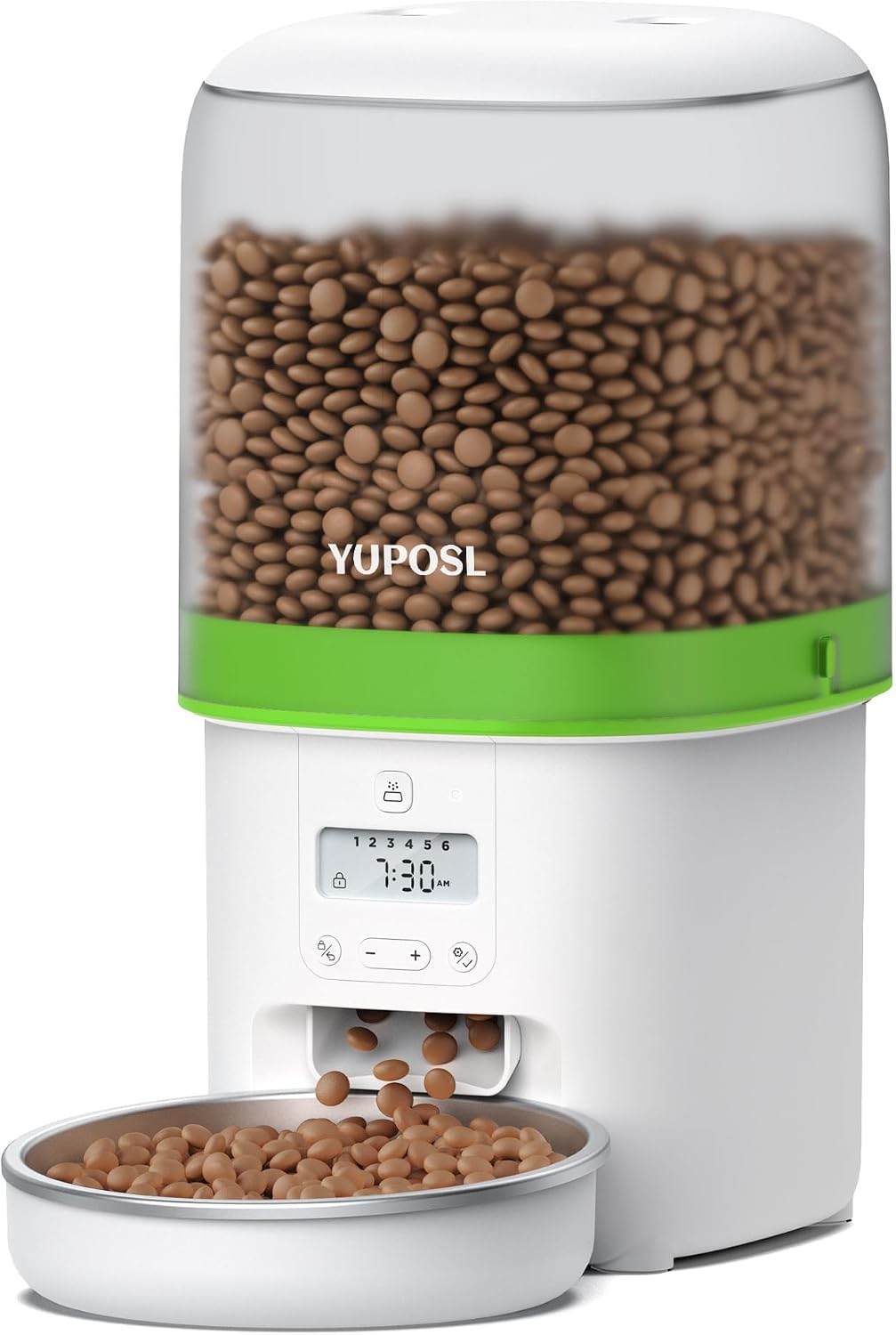
- Capacity
- 4 L
- Features
- Timed
- Price range
- $40–60
★ 4.4/5 from 12,373 verified Amazon reviews. The multi-cat choice: a 4L timed feeder with the same flexible programming as the top pick (1–6 meals per day, 1–16 portions), built to handle the higher throughput of a two-cat household. The large hopper means you're not refilling every other day, and the 180-day battery life plus desiccant freshness bag keep maintenance low. Like the other timed models here, it works for both cats and small dogs. If your household has more than one furry stomach to fill, this capacity class is where we'd start.
- Pros
- 4L capacity handles 1–2 cats easily
- 1–6 meals and 1–16 portions per meal
- 180-day battery life
- Desiccant bag keeps food fresh
- Cons
- No WiFi/app control
- Dry food only
- Identical spec to several 4L timed models – compare prices
Automatic Cat Feeder 4L Timed – Portion Control Specialist
Best Portion Control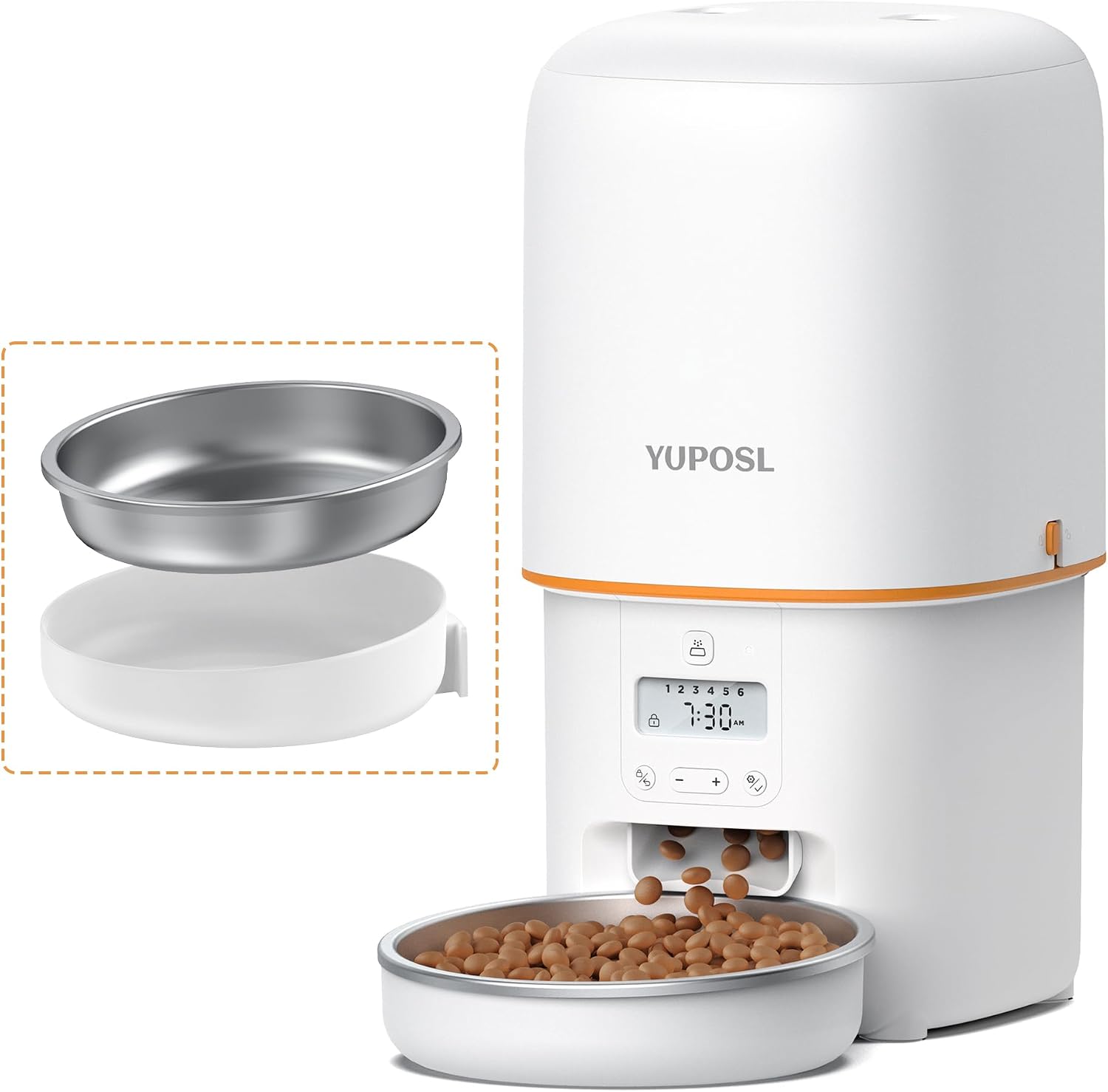
- Capacity
- 4 L
- Features
- Timed
- Price range
- $40–60
★ 4.4/5 from 12,373 verified Amazon reviews. The pick for owners fighting the bulge. Portion control is where this class of feeder earns its keep, and this 4L timed model delivers the widest useful range: 1–16 portions per meal, up to 6 meals a day. That granularity matters for weight management – you can dial in a precise daily allowance rather than eyeballing scoops. The 180-day battery life and desiccant freshness bag round out a very complete timed package. For overweight cats or picky eaters on a strict feeding plan, this is the one to start with.
- Pros
- Fine-grained 1–16 portion control
- Up to 6 small meals per day
- 4L capacity, 180-day battery life
- Great fit for weight-management plans
- Cons
- No WiFi/app control
- Dry food only
- Specs overlap with other 4L timed models – pick on price
Comparison Table
| Model | Price | Capacity | WiFi? | Best for |
|---|---|---|---|---|
| 4L Feeder, Anti-Jam (B0C5JVM68Q) | $40–60 | 4L | No | Overall |
| PETLIBRO WiFi 5L (B0D44QYZ7Z) | $80–100 | 5L | Yes | Smart/App control |
| VOLUAS 4L (B09N6SX5ZD) | $45–65 | 4L | No | Value |
| 2L Budget Feeder (B0D5Y1HSN4) | $35–50 | 2L | No | Budget / single cat |
| 4L Timed (B0DHVHHZLY) | $40–60 | 4L | No | Multiple cats |
| 4L Timed (B0C2J9C8R1) | $40–60 | 4L | No | Portion control |
How to Choose an Automatic Cat Feeder
Capacity: 4L vs 2L vs 5L
Capacity is the first decision, and it's driven by how many cats you have and how often you want to refill. A 4L hopper holds roughly 3–4 weeks of dry food for a single average cat; for two cats, expect 1.5–2 weeks between refills. A 2L model is fine for one cat but needs weekly attention. The PETLIBRO's 5L is the largest here and makes sense for two cats or long trips. Rule of thumb: when in doubt, size up – a larger hopper only costs you a few extra dollars and saves you refill trips.
Portion control: the weight-management feature
All six feeders here offer programmable portion sizes, but the range matters. Models with 1–16 portions per meal give you the fine control needed to enforce a vet-approved daily calorie target. Combined with 1–6 meals per day, you can split a cat's allowance into several small meals – useful for overweight cats, kittens, and seniors. If weight management is your goal, treat portion granularity as a must-have, not a nice-to-have.
Anti-jam: the most underrated feature
The #1 complaint across automatic feeder reviews is jamming – kibble gets stuck, the auger spins, and no food comes out. Our top pick (B0C5JVM68Q) explicitly addresses this with an anti-jam design, and it's worth prioritizing even if you have to compromise elsewhere. Some jam issues also trace back to kibble shape: very large or oddly shaped pieces can defeat any mechanism, so check the manufacturer's kibble-size guidance for your food.
WiFi/app vs timed: do you need the smart stuff?
Timed feeders (the other five in this list) are programmed on the device itself and work forever with zero connectivity. WiFi feeders add remote feeding from your phone, feeding history, and low-food alerts – genuinely useful if you travel or want data, but they cost more, depend on your network, and need app setup. Honest take: if you only need consistent meal times, a timed feeder does 95% of the job for 50% of the price. Choose WiFi if you want remote control and notifications.
Battery and power
Most of the feeders here claim 180-day battery life, which means you're changing batteries a couple of times a year. The VOLUAS adds a dual power supply with power-off memory, so its schedule survives a blackout – a real advantage if your power blinks. Whatever you buy, keep spare batteries handy and set a reminder; a feeder with a dead battery is just an expensive bowl.
Cleaning and maintenance
A feeder gets greasy from kibble oils and collects dust in the hopper. Look for models where the hopper, auger, and bowl come apart without tools and are dishwasher-safe or easy to hand-wash. Stainless steel bowls (as on the top pick and the PETLIBRO) resist scratches better than plastic. Plan a full clean every 2–4 weeks, and wipe the dispensing opening when you refill.
Freshness: how the hopper protects your kibble
Dry food goes stale when it's exposed to air and moisture – and a stale kibble is a kibble cats start refusing. The simplest freshness feature is a sealed or airtight hopper lid, which several models here pair with a desiccant bag inside the hopper to absorb humidity. The PETLIBRO goes furthest with its Lock-Fresh airtight technology. If your cat is a slow eater or you buy in bulk, don't skip this: a feeder that keeps food crisp for weeks beats one that needs refills of stale leftovers.
Noise: yes, it matters
Feeders are quiet most of the time – then loudly dispense for a few seconds, often right before dawn. Some cats flinch at the sound and refuse to approach; others come running. Review patterns suggest dispensing noise is one of the most common reasons cats initially avoid a new feeder. There's no reliable noise spec published for most models, so read owner reviews for comments on dispensing volume, and introduce the feeder gradually: run it near your cat at a time they're hungry, so they associate the sound with food.
Common Mistakes to Avoid
- Choosing capacity last. Buyers often pick features first and discover the hopper is too small for their household. Decide capacity (2L vs 4L vs 5L) before anything else – it drives refill frequency for years.
- Ignoring jam reports. A feeder that jams once a week is worse than none. If your kibble is large or oddly shaped, prioritize models with anti-jam design or check owner reports for your specific food.
- Switching food overnight. Cats are creatures of habit. Switch to the feeder with a transitional plan: keep their usual bowl for a few days, let the feeder dispense the same food, and only then remove the bowl.
- Forgetting battery checks. The 180-day battery life claims are helpful, but batteries still die. Set a calendar reminder every few months and keep spares in the drawer.
- Using it for wet food. Repeating this because it's the #1 source of returns: automatic feeders are dry-food devices. Wet food spoils in the hopper and clogs the auger.
- Skipping the manual. Portion size is a dial or button setting on every model here – take two minutes to verify what a single portion actually looks like in the bowl before trusting it for a week away.
FAQ
How many times a day should a cat be fed?
Most adult cats do well on 2–3 meals per day, while kittens and some seniors need 4–6 smaller meals. An automatic feeder with 1–6 meals per day covers all of these – just match the schedule to your cat's age, health, and your vet's advice.
Do automatic feeders work for multiple cats?
Yes, with planning. A single feeder can't tell cats apart – the greedy cat may eat both portions. For multi-cat homes, look for a large capacity like 4–5L and either feed cats in separate rooms or use feeders with dual bowls (like the PETLIBRO) so both cats eat at once. If one cat needs a special diet, two separate feeders in different rooms are the safer setup.
Can I use wet food in an automatic feeder?
No – automatic feeders are designed for dry kibble only. Wet food spoils quickly inside the hopper and can clog the dispensing mechanism. For wet food meals, you'll still need to feed manually or use a chilled, wet-food-specific dispenser.
How long does a 4L feeder last for one cat?
Depending on portion sizes, a 4L hopper holds roughly 3–4 weeks of dry food for a single adult cat. A 2L feeder lasts about half that. That's why 4L models dominate our recommendations – fewer refills, more peace of mind.
Bottom Line
For most households, the 4L Automatic Cat Feeder with Anti-Jam Design (B0C5JVM68Q) is the safe pick: generous capacity, jam-resistant dispensing, a stainless steel bowl, and one of the strongest rating bases in its class. Smart-home owners who travel should look at the PETLIBRO WiFi Feeder for remote control and dual bowls, and budget shoppers can't go wrong with the 2L Timed Feeder – the fundamentals, done well, at the lowest price.
Whichever you choose: pick the capacity your cat count demands, prioritize anti-jam and portion control, and keep it clean. A feeder that dispenses reliably, every day, is worth more than one with a hundred features that jams on day three.